
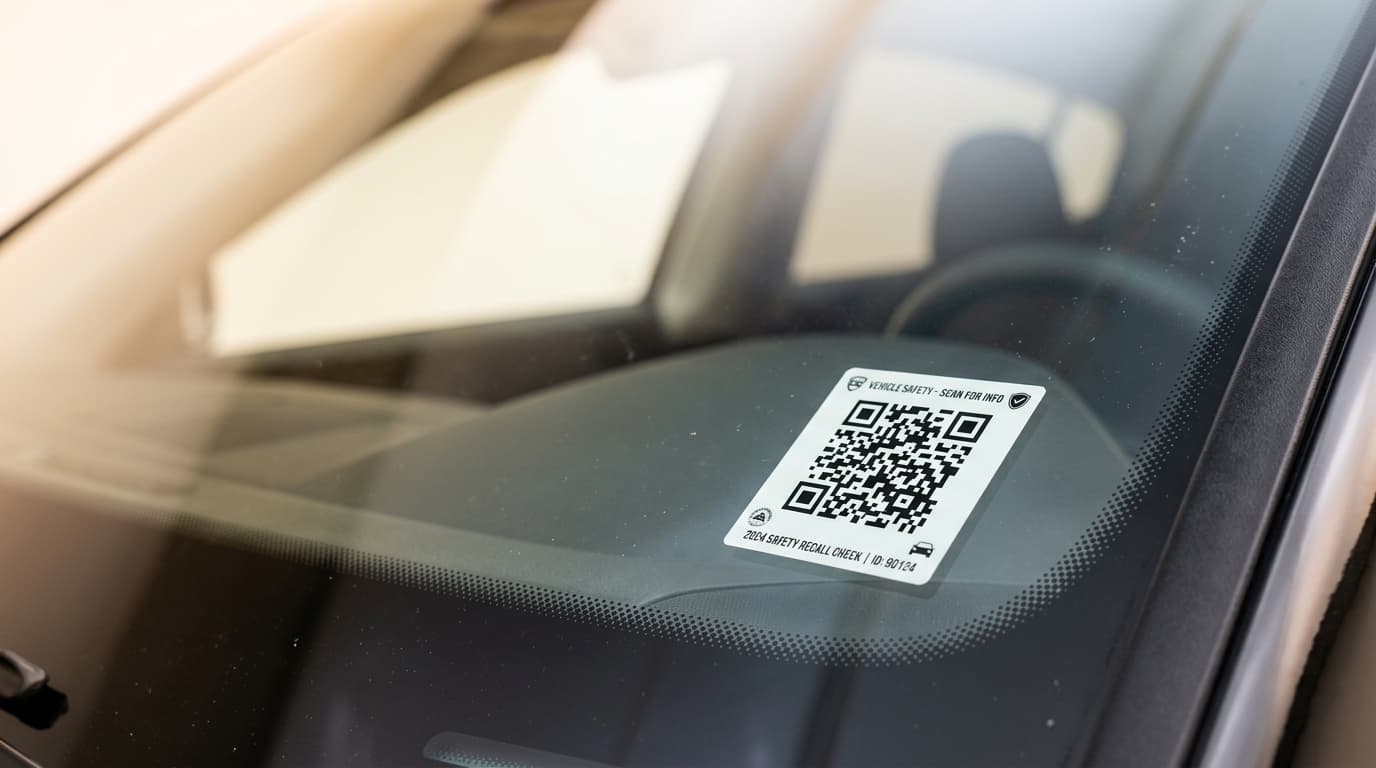
Optical Contrast in Automotive Glazing: Why Clean Placement Matters
A deep engineering breakdown of automotive laminated glass, acoustic PVB plies, ceramic frit dot matrices, and ISO/IEC 18004 scannability under 100,000 lux Indian sunlight.

Guides for the road, the vehicle and the identity. FIELD NOTES on vehicle safety, QR identity, privacy and responsible connection.
When an unexpected collision or breakdown occurs on a high-speed highway, the initial minutes are dominated by confusion. Following this rigorous, step-by-step action chain protects both the responder and the injured motorist.
The Roadside Bystander Action Chain: First Steps at a Highway Incident
Optical Contrast in Automotive Glazing: Why Clean Placement Matters
How Emergency Contacts Receive and Respond to Decal Relays
Separating Contact Channels from Residential Addresses
The Dual-Layer Identity: How Physical QR Pairs with Digital Security
A deep engineering breakdown of automotive laminated glass, acoustic PVB plies, ceramic frit dot matrices, and ISO/IEC 18004 scannability under 100,000 lux Indian sunlight.
A deep architectural walkthrough of how VaahanSafe decouples physical sticker inventory from authenticated vehicle ownership records on Cloudflare D1.
Fear of legal entanglement and police harassment has historically prevented 80% of bystanders from assisting accident victims. Indian law now guarantees absolute civil and criminal immunity, strict confidentiality, and free hospital admission.
Encoding raw mobile numbers, residential addresses, or blood groups directly into static QR stickers permanently compromises driver privacy. If your phone number changes or your vehicle is transferred, static code becomes perpetual exposure.
VaahanSafe resolves an opaque cryptographic public identifier through an authenticated telephony relay—enabling immediate roadside emergency response without exposing a single private record to bystander viewfinders.

Clear, authoritative protocols for optical placement, emergency contact designation, and data minimization.
Optimal windshield glass coordinates, ceramic frit avoidance, and CMVR Rule 100 sightline compliance.
Designating verified priority contacts, WhatsApp alerts, and sequential masked call relays.
The three-tier boundary model isolating private residential data from roadside camera scans.
Traditional paper visiting cards left on dashboards broadcast residential addresses and personal phone numbers to every passerby. VaahanSafe enforces an ironclad three-tier boundary separating private account records from the public safety projection.
Connecting motorists with verified emergency contacts, bystander relays, and immediate roadside assistance without displaying personal phone numbers or paper visiting cards on windshields.