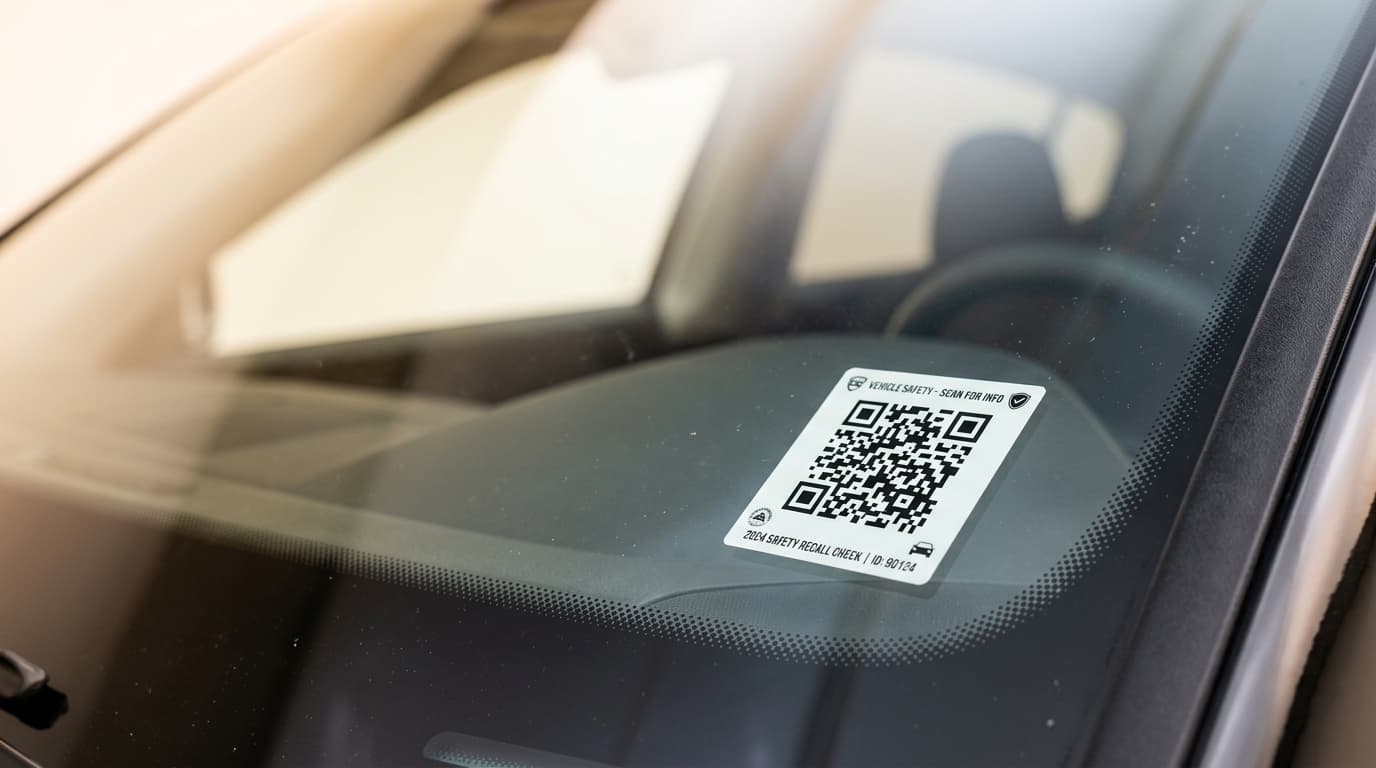
“Modern automotive windshields are far more than transparent glass panes. They are complex multi-layer optical sandwiches featuring acoustic polyvinyl butyral (PVB) dampening cores, ceramic enamel frit borders, infrared-reflective metalized sputter coatings, and hydrophobic surface treatments. Affixing a roadside safety decal without understanding this optical physics results in focus hunting, camera flare, and delayed emergency scans. This guide breaks down the science of automotive glass placement.”
1. Anatomy of Automotive Laminated Glass: PVB, Acoustic Cores, and Sputtered Coatings
Under Indian automotive safety standard AIS-026 and CMVR Rule 100, front windshields must be manufactured from laminated safety glass. A typical automotive windshield comprises an outer 2.1mm soda-lime glass ply, an inner 0.76mm acoustic Polyvinyl Butyral (PVB) interlayer, and an interior 2.1mm glass ply.
In modern premium vehicles and electric vehicles (EVs), the glass is further treated with magnetron-sputtered metalized layers (silver or titanium oxides) designed to reflect solar infrared radiation. While these coatings dramatically reduce cabin heat in 45°C Indian summers, they introduce internal reflection and polarization shifts that can impair optical camera sensors if the decal lacks an opaque barrier layer.
2. The Ceramic Matrix (Frit): Why Black Dots Destroy QR Contrast
Windshield borders feature a solid black band that transitions into a halftone dot pattern known as the ceramic frit. This frit serves two critical mechanical functions: it creates a rough bonding surface for the polyurethane windshield sealant and acts as a thermal gradient buffer, preventing localized glass shattering from solar heat accumulation.
However, affixing a QR code over the ceramic frit creates optical interference. The black enamel dots break the quiet zone (the required blank margin surrounding a QR symbol) and degrade the modulation ratio. When sunlight strikes the textured frit, microscopic shadows fall into the code's white data modules, dropping optical contrast below the 4:1 ratio required by smartphone autofocus algorithms.
3. Central Motor Vehicles Rules (CMVR) Rule 100 & AIS-045 Sightline Mandates
Automotive decal placement in India is strictly governed by statutory visibility regulations. CMVR Rule 100(2) stipulates that the front windshield must maintain at least 70% Visual Light Transmission (VLT) across Zone A and Zone B of the driver's forward sightlines as defined under Automotive Industry Standard (AIS) 045.
| Windshield Coordinate | Sightline Impact | CMVR Rule 100 Status | Optical Scannability | Bystander Safety |
|---|---|---|---|---|
| Passenger Lower Corner (Left) | Outside primary wiper sweep | Fully Compliant (Safe Zone) | 6.8:1 Contrast (Optimal) | Safe: Footpath/curb access |
| Directly over Ceramic Frit | Thermal distortion zone | Non-compliant (Degraded VLT) | 1.8:1 Contrast (Fails in low light) | Moderate: High glare risk |
| Center Top (Behind Mirror) | Interferes with ADAS cameras | Prohibited under AIS-140/ADAS | 4.2:1 Contrast (Acceptable) | Unsafe: Helper reaches into road |
| Driver Lower Corner (Right) | Direct driver forward sightline | Illegal under CMVR Rule 100 | 6.5:1 Contrast | Extremely Dangerous: Lane exposure |
4. ISO/IEC 18004 Symbology: Error Correction Level Q and Tropical Sunlight
Standard consumer QR codes typically utilize Error Correction Level L (7% recovery) or Level M (15% recovery) to maximize data capacity. However, in automotive environments subjected to road salt, monsoon rain streaks, diesel exhaust soot, and wiper blade wear, Level L codes fail rapidly.
VaahanSafe enforces ISO/IEC 18004 Level Q (Quarter) Reed-Solomon algebraic error correction across all production stickers. Level Q allows up to 25% of the total symbol area to be completely destroyed, scratched, or obscured by highway grime while still achieving 100% deterministic mathematical decoding.
5. Adhesion Chemistry: Optical Pressure-Sensitive Adhesives vs Thermal Degradation
Automotive glass in northern and central India experiences extreme thermal cycling, ranging from 2°C in winter nights to interior dashboard temperatures exceeding 75°C when parked in direct summer sun. Standard vinyl adhesives yellow, bubble, and outgas plasticizers that form a cloudy film over the glass.
VaahanSafe decals utilize an optically clear, cross-linked acrylic pressure-sensitive adhesive (PSA) with UV-inhibitor stabilizers. The adhesive maintains peel adhesion strength exceeding 18 N/25mm while allowing residue-free removal during windshield replacement.
Can I place the VaahanSafe decal on the rear windshield instead?
Yes. On vehicles where passenger-side quarter glass is tinted or unavailable, placing the decal on the lower corner of the rear windshield or fixed quarter glass is fully compliant. Ensure the decal does not intersect electric demister heating filaments or wiper sweep paths.
Will the decal damage my window tint film?
If your vehicle has aftermarket interior sun-control film, you should affix the decal on the interior glass surface BEFORE film application, or use the exterior automotive-grade weatherproof decal variant to avoid peeling the film during removal.
Why does my phone camera scan faster than generic QR readers?
VaahanSafe decals encode short, high-entropy opaque URLs (e.g. `https://qr.vaahansafe.com/vs_8f4k9a21`) rather than heavy text payloads. The smaller matrix size (Version 2 to 4) yields larger physical module squares, allowing phone autofocus lenses to lock on instantly even through dirty glass.
- Central Motor Vehicles Rules (CMVR) 1989, Rule 100 — Safety glass specifications & light transmissionSource: morth.nic.in
Statutory 70% VLT forward sightline compliance and wiper sweep exclusion rules
- Automotive Industry Standard AIS-045 & AIS-026 — Safety glazing materials for motor vehiclesSource: araiindia.com
Optical properties, thermal test procedures, and laminated glass shatter specifications
- ISO/IEC 18004:2015 — Information technology automatic identification and QR code symbologySource: iso.org
Reed-Solomon Level Q error correction, quiet zone boundaries, and contrast modulation
Canonical reference guidelines and regulatory specifications under VaahanSafe Documents.
Learn how the vehicle safety identity works.
Industrial UV-cured optical decals connecting bystanders directly to your emergency contacts without exposing private phone numbers or home addresses.
Preparing Windshield Glass for Weatherproof Decal Bonding
A technical installation guide on degreasing glass surfaces, avoiding micro-air pockets, and maintaining adhesive cross-linking across Indian monsoon and summer extremes.
The Roadside Bystander Action Chain: First Steps at a Highway Incident
A pin-to-pin operational protocol for the critical first 15 minutes at an Indian highway accident: perimeter safety, optical QR relays, emergency dispatch, and cervical stabilization.